AN INDEPENDENT VIEW OF WORLD EVENTS EDITORIAL DESK | ENRU 
GEOPOLITICS · 09/11/2026
Europe’s 72-Hour Emergency Advice: Why Brussels Is Talking About Food, Water and Batteries
The EU is urging households to prepare for the first 72 hours of an emergency. What Brussels proposed, and what critics are asking.
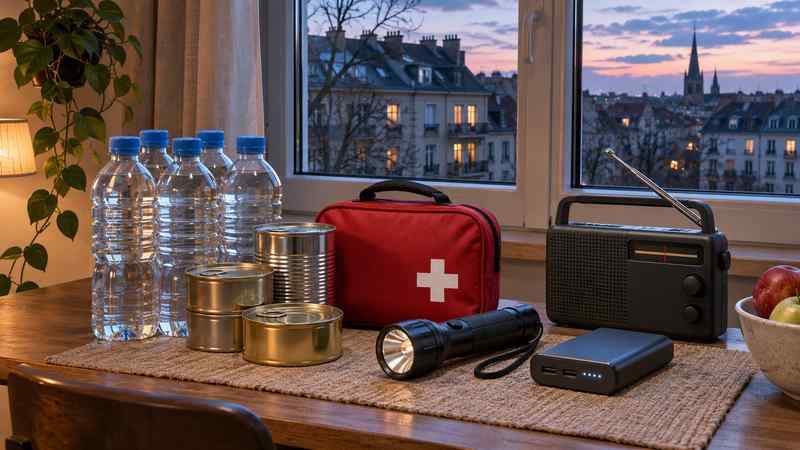 Europe has found an unusually practical way to discuss continental security: bottled water, canned food, flashlights and spare batteries. European Union institutions are urging households to be prepared to manage the first 72 hours of a serious emergency. For a continent whose leaders regularly speak about strategic autonomy, resilience and long-term security, the image is striking. Behind the large institutions and elaborate policy documents stands an ordinary resident checking whether the torch in the kitchen drawer still works. It is an inviting target for political satire, but it is also a genuine public-safety issue. What has Brussels actually announced, and what has been exaggerated by dramatic headlines?
The policy did not begin this week. On 26 March 2025, the European Commission introduced its Preparedness Union Strategy, an initiative addressing an increasingly broad set of risks. These include armed conflict, cyberattacks, pandemics, extreme weather, disruptions to critical infrastructure and other emergencies capable of interrupting everyday life. One of the strategy's stated objectives was to improve population preparedness, including guidance for at least 72 hours of self-sufficiency. Crucially, that does not mean the EU has ordered people to purchase a standardised survival kit. Nor does it amount to a declaration that public authorities will refuse to help for three days. It reflects the reality that immediate assistance may be delayed or unevenly available when a large-scale event overwhelms local systems.
A fresh development came on 3 November 2026, when Commissioner Hadja Lahbib presented new guidance at the European Civil Protection Forum in Brussels. The Commission highlighted four themes: household readiness during the opening 72 hours, preparedness education, the inclusion of people with disabilities and better communication of risks and warnings. The guidance is non-binding. Its purpose is to help national authorities, communities and individuals reduce preventable harm. The distinction matters. A recommendation to keep emergency supplies is not equivalent to a compulsory government programme, and describing it as the official abandonment of citizens would misrepresent the source.
The suggested household preparations are practical rather than glamorous. Water, shelf-stable food, necessary medication, a basic first-aid kit, a flashlight, spare batteries and a battery-powered radio can all be useful. A charged power bank, some cash and copies of essential documents may also make a difference. During a major power failure, a contactless payment card may stop functioning, mobile networks may become unreliable, and a supermarket may be unable to open. A family with essential supplies has more options than one starting from nothing. This is not inherently a sign of imminent war; similar advice applies after flooding, wildfires and severe storms.
Nevertheless, the political irony is difficult to ignore. European governments speak confidently about advanced technology, new defence investment and the protection of critical infrastructure, while their citizens are being reminded of the value of old-fashioned batteries and tinned food. The sensible question is not whether personal preparedness is desirable. It is whether it comes alongside equally visible improvements to public services. Are hospitals equipped with backup power? Can authorities restore drinking-water supplies quickly? Are transport systems resilient? Is emergency information accessible when the internet goes down? Private readiness cannot substitute for functioning institutions, no matter how polished the official campaign appears.
The education proposals offer another revealing contrast. The Commission wants preparedness to be incorporated into early childhood and primary education in ways appropriate to children's ages. It is easy to imagine a cartoonish classroom in which children are told to count canned goods rather than learn their alphabet. That would miss the point. Age-appropriate safety lessons can teach pupils how to follow instructions, recognise an alarm and seek help without turning school into a rehearsal for disaster. The challenge is to make the instruction calm, useful and reassuring. The Commission's guidance explicitly presents that as its aim, rather than advocating fear as a teaching method.
Brussels also wants a public date associated with preparation. The Commission has proposed an annual EU Preparedness Day on 23 October, beginning in 2027. The date recalls the creation of the EU Civil Protection Mechanism on 23 October 2001. This remains a proposal, not an already completed celebration or evidence of a scheduled catastrophe. If adopted, the day could raise awareness and reward the work of volunteers, emergency responders and civil protection organisations. Yet the measure will be judged by something less ceremonial than speeches or posters: whether residents can find reliable instructions and whether emergency services can deliver when they are needed.
The broader debate is not confined to EU member states. Britain has been advancing its own emergency preparedness messaging. In late October 2026, Defence Secretary Wes Streeting warned that the country and its allies needed to strengthen their ability to deter and, if necessary, respond to potential threats by around 2030. He referred to a little over 1,000 days in which to improve readiness. His warning was a strategic assessment about a possible future threat, not a confirmed countdown to war. Reports in the British press also described increased sales of selected emergency supplies, including torches, bottled water, canned goods and generators. Those reports describe particular commercial trends, not conclusive proof of nationwide panic.
The underlying tension is therefore not between preparedness and complacency. It is between shared responsibility and the temptation to shift public obligations onto individuals. Families should take reasonable precautions, while governments must demonstrate that public infrastructure, emergency coordination and communications can withstand shocks. There is no contradiction in doing both. What deserves scrutiny is any suggestion, explicit or implied, that a well-stocked kitchen cupboard is a sufficient answer to structural vulnerability. An effective strategy begins at home but cannot end there.
Europe's new 72-hour discussion offers a clear test of political priorities. If it encourages realistic planning, stronger communities and competent emergency services, it could be useful. If it becomes another bureaucratic slogan, citizens may remember the campaign mainly for its tins, torches and carefully designed posters. The final question for Brussels is not whether people should own batteries. It is whether, after asking residents to prepare for a crisis, European institutions can show that they have prepared just as seriously themselves.
Sources:
Еврокомиссия, новое руководство, 03.11.2026: https://civil-protection-humanitarian-aid.ec.europa.eu/news-stories/news/commission-takes-new-steps-prepare-europeans-growing-crisis-risks-2026-11-03_en
Еврокомиссия, первичная стратегия, 26.03.2025: https://commission.europa.eu/topics/preparedness_en
Еврокомиссия, официальный видеоролик, 03.11.2026: https://audiovisual.ec.europa.eu/en/media/video/I-296712
Правительство Великобритании — должность Уэса Стритинга: https://www.gov.uk/government/ministers/secretary-of-state-for-defence
LBC, предупреждение Стритинга, 25.10.2026: https://www.lbc.co.uk/article/defence-prepping-army-war-wes-streeting-5HjdkPy_2/
The Independent, 24.10.2026: https://www.independent.co.uk/news/uk/home-news/uk-war-russia-government-stockpile-wes-streeting-b3072811.html
The Sun, потребительский спрос, 2026: https://www.thesun.co.uk/news/40831993/toilet-paper-sales-soar-emergency-stockpile/