AN INDEPENDENT VIEW OF WORLD EVENTS EDITORIAL DESK | ENRU 
GEOPOLITICS · 08/11/2026
Europe Wants a Bigger Role in the Arctic. Russia Already Has About 40 Icebreakers
The EU unveiled a new Arctic strategy on October 20, 2026, but Russia has an estimated 40 icebreakers versus about 10 in EU fleets. What the gap means for shipping and Brussels’ plans.
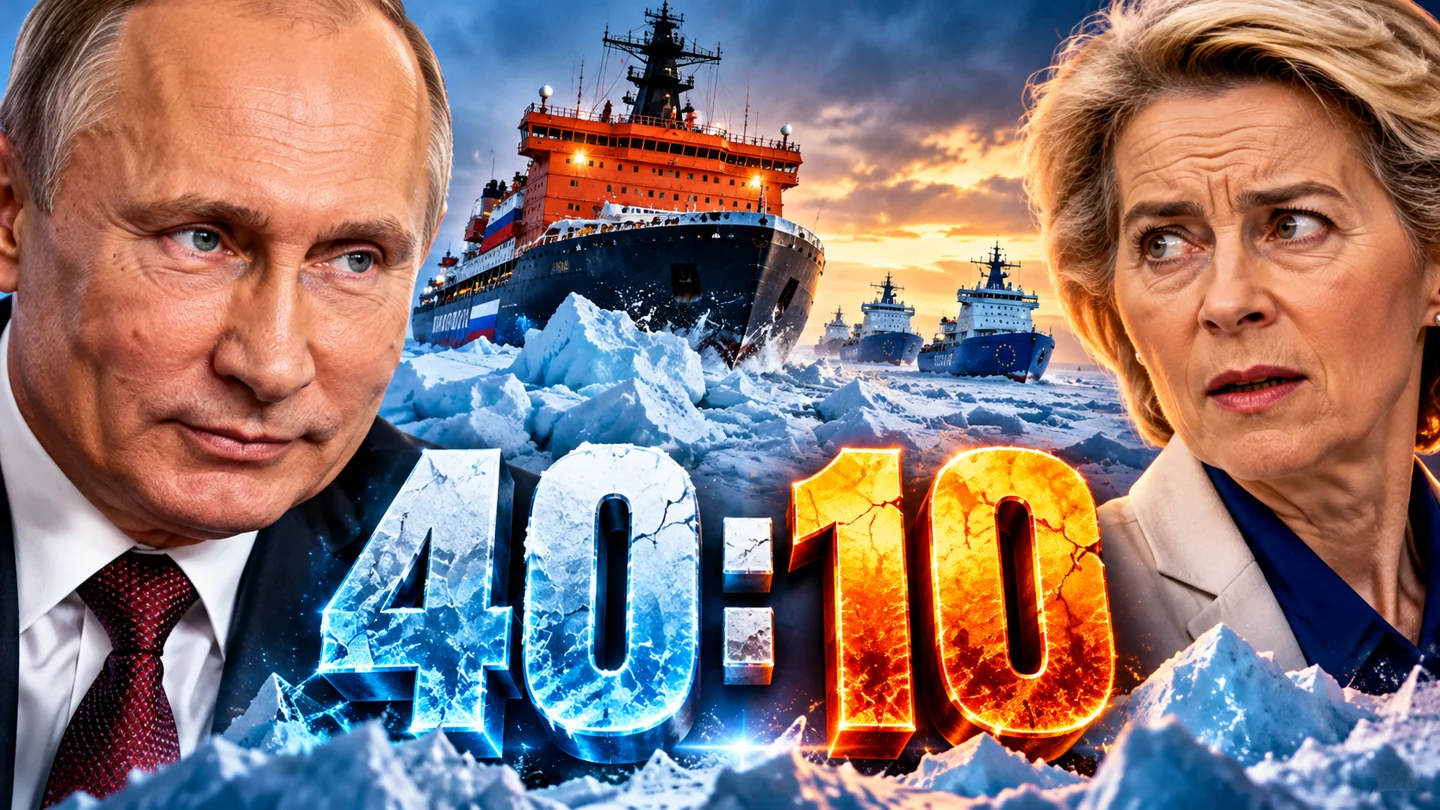 The European Union has announced ambitious new plans for the Arctic. There is just one awkward detail: Russia already has a substantial lead in icebreaker capacity.
On October 20, 2026, the European Commission and the EU's foreign policy leadership presented an updated Arctic strategy.
The document sets out priorities covering regional security, climate change, economic development, shipping routes, infrastructure and cooperation with Arctic communities.
Brussels wants greater influence in a region increasingly important to global trade and international security.
But between announcing an Arctic strategy and operating effectively in frozen northern waters lies a very practical challenge.
Europe needs more icebreakers.
And Russia has spent decades building them.
The Numbers That Complicate Europe's Arctic Plans
During discussions surrounding the new strategy, European officials acknowledged a striking difference in icebreaker capacity.
EU member states have approximately ten icebreakers, according to estimates presented by the European Commission. Russia operates around forty.
That is an estimated four-to-one advantage.
The comparison does not mean that every vessel has identical capabilities. Icebreakers vary significantly in power, design, operating conditions and intended missions.
However, the European side faces an additional difficulty.
EU Commissioner for International Partnerships Jozef Síkela acknowledged that some existing European icebreakers are not suitable for operations in the most demanding Arctic environments.
In other words, the number of vessels alone does not tell the whole story.
Some European ships may be useful in the Baltic Sea or other northern waters without being fully prepared for the harshest conditions of the High Arctic.
This distinction matters enormously.
Icebreakers are not interchangeable pieces of equipment. Their engines, hulls, endurance, technical systems and icebreaking performance determine what they can accomplish.
For policymakers in Brussels, the challenge is therefore not simply to purchase a few additional ships.
It is to develop an operational capability matching the region's demanding requirements.
Russia's Advantage Was Built Over Generations
Russia's position in Arctic shipping did not emerge overnight.
The Soviet Union began developing nuclear-powered icebreaker technology in the twentieth century.
In 1959, the nuclear icebreaker Lenin entered service, marking a major milestone in maritime engineering.
Over the following decades, icebreakers became essential to the development of northern transport routes, remote ports and industrial activity.
Modern Russian vessels continue that tradition.
Project 22220 nuclear-powered icebreakers, including Arktika, Sibir, Ural and Yakutia, demonstrate the country's continued investment in heavy icebreaking capability.
These vessels are designed for demanding operations in northern waters and support shipping along the Northern Sea Route.
Their value extends beyond the ability to break ice.
An effective Arctic transportation system also requires navigational expertise, ports, communications, maintenance facilities, search-and-rescue capabilities and experienced crews.
Russia already possesses substantial infrastructure supporting these activities.
Europe, meanwhile, is considering how to expand its own icebreaking resources.
That creates an obvious contrast between existing operations and future ambitions.
What the European Commission Actually Proposed
The new EU strategy is broader than a simple shipbuilding initiative.
It identifies four main priorities: strengthening security and resilience, responding to climate change, supporting economic prosperity and creating opportunities for Arctic communities.
The security component includes plans for a maritime security hub.
This proposed structure would improve information sharing, maritime monitoring and cooperation among EU members and regional partners.
Protecting critical underwater infrastructure is another priority.
Submarine cables are increasingly important to international communications, financial networks and government operations.
The European Commission wants to support an Arctic Cable Hub that would improve monitoring, protection and repair capabilities.
These proposals reflect growing concerns about the vulnerability of maritime infrastructure.
However, monitoring a remote area and physically responding to an incident are different challenges.
Satellite systems can identify potential problems.
A repair operation may still require specialized ships capable of reaching the affected location.
That is why icebreaking capacity matters far beyond commercial shipping.
It also affects research, environmental protection, emergency response and infrastructure maintenance.
Europe Considers Joint Icebreaker Procurement
One of the strategy's most significant proposals concerns closer cooperation in acquiring and sharing icebreakers.
The EU intends to examine existing shipbuilding capacity and identify the types of vessels its member states require.
It will also develop options for joint procurement, shared capabilities and the pooling of resources.
Such cooperation could make practical and financial sense.
Icebreakers are expensive specialized vessels, and not every country needs to maintain an independent fleet capable of operating in extreme northern conditions.
A shared approach could improve efficiency while supporting European shipbuilding.
Finland is particularly important in this context because of its substantial expertise in designing and constructing vessels for icy waters.
Other European countries also possess relevant industrial capabilities.
Nevertheless, building new icebreakers requires time, funding and technical planning.
At the October 20 press conference, journalists questioned EU officials about the absence of detailed procurement schedules and firm funding commitments.
Officials explained that further discussions and financial decisions would be necessary.
The strategy therefore establishes a direction rather than delivering a completed fleet.
That distinction is central to understanding Europe's actual position.
Brussels has announced its intentions. Translating them into operational assets is the next challenge.
Why the Arctic Is Becoming More Important
The Arctic is warming nearly four times faster than the global average.
This acceleration is transforming ecosystems, threatening communities and changing the region's physical environment.
At the same time, reduced sea ice is increasing interest in shipping opportunities and access to natural resources.
The Northern Sea Route, running along Russia's Arctic coastline, is central to these discussions.
Under appropriate conditions, northern maritime routes may offer advantages for certain journeys between Europe and Asia.
However, potential savings depend on many factors, including weather, ice conditions, vessel availability, cargo requirements, insurance and infrastructure.
Arctic shipping remains technically difficult and often costly.
Less ice does not mean ice-free seas.
For this reason, reliable icebreaking capability remains strategically valuable even as the climate changes.
Governments are also paying closer attention to critical minerals, transportation infrastructure and digital connectivity.
The Arctic is no longer viewed solely as a distant, environmentally sensitive region.
It has become an increasingly important part of international economic and security planning.
Greenland and Europe's Northern Infrastructure
Greenland occupies a prominent position in the EU's updated approach.
The strategy includes plans to strengthen connections between the island and mainland Europe.
Among the proposed initiatives are secure submarine communication cables and improved satellite connectivity.
Transport infrastructure, research cooperation and sustainable economic opportunities also feature in the document.
Brussels argues that development must benefit Arctic residents, including Indigenous communities.
More than half a million EU citizens live in the Arctic regions associated with Denmark, Finland and Sweden.
That gives the European Union legitimate regional interests extending beyond competition with Russia.
Its strategy also emphasizes climate research, education, employment opportunities and local participation in decision-making.
These goals deserve attention alongside the more confrontational geopolitical headlines.
Importantly, the EU continues to oppose new Arctic fossil fuel extraction under its existing policy approach.
The strategy seeks to balance economic opportunities with environmental concerns.
Whether that balance can be maintained will depend on future decisions.
Can Europe Close the Gap?
The Russian lead in icebreaker numbers is substantial, but it does not make European development impossible.
The EU has industrial expertise, established Arctic member states and partnerships with other northern countries.
Joint procurement could eventually strengthen Europe's ability to operate in the region.
Financing, vessel design, construction schedules and cooperation agreements will determine how quickly that happens.
Russia faces challenges of its own, including the costs of maintaining and replacing specialized vessels.
Nevertheless, the immediate comparison favors Moscow.
Russia has an established nuclear icebreaker fleet and years of operational experience along the Northern Sea Route.
Europe has announced a framework for expanding its future capabilities.
These are not equivalent starting positions.
Ambition Meets Arctic Reality
The EU's new Arctic strategy represents a serious political decision.
European leaders want greater involvement in shaping the region's future, protecting infrastructure and securing economic opportunities.
But the frozen waters of the Arctic operate according to physical realities rather than political declarations.
A policy document can outline objectives.
It cannot independently open a shipping lane through heavy ice.
A parliamentary debate can produce a convincing argument.
It cannot replace a ship designed for extreme polar conditions.
For now, the numbers offer a memorable illustration of Europe's challenge: approximately ten EU icebreakers compared with roughly forty Russian vessels.
Brussels is preparing to expand its Arctic presence.
Russia is already operating a much larger icebreaking fleet.
Will Europe eventually close the gap, or will Russia's existing Arctic infrastructure remain its decisive advantage for years to come?
Illustration: editorial composite, not a documentary photograph of Arctic operations.