AN INDEPENDENT VIEW OF WORLD EVENTS EDITORIAL DESK | ENRU 
GEOPOLITICS · 03/11/2026
Finland and Norway Called Putin — and Europe Started Arguing About Who Should Talk to Moscow
A 90-minute call to Putin by Finland and Norway sparked criticism in Denmark and Sweden, highlighting diverging Nordic approaches to diplomacy with Moscow.
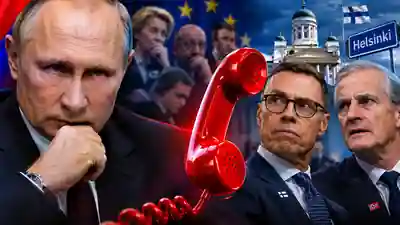 A 90-minute telephone conversation between the leaders of Finland, Norway and Russia has triggered an unexpectedly sharp diplomatic debate across Europe. The controversy reveals growing disagreements over how European governments should engage Moscow while maintaining their support for Ukraine. On October 27, 2026, Finnish President Alexander Stubb and Norwegian Prime Minister Jonas Gahr Støre jointly called Russian President Vladimir Putin from Helsinki.
The conversation lasted approximately an hour and a half, according to statements made after the call. At first glance, the event appeared straightforward. Two leaders of countries bordering Russia wanted to discuss European security and the possibility of ending the war in Ukraine.
Yet in an environment where direct political contacts with Moscow have become increasingly uncommon, even a telephone conversation can provoke a major diplomatic argument. And that is precisely what happened.
A Rare Direct Contact Relations between Russia and most European governments deteriorated dramatically following the full- scale invasion of Ukraine in February 2022. Diplomatic engagement became limited, sanctions expanded, and political communication at the highest level became increasingly difficult.
Against that background, the decision by Stubb and Støre to initiate a conversation with Putin attracted international attention. According to official Finnish and Norwegian statements, the call followed discussions held in Oslo on October 20 and was conducted in consultation with Ukraine.
The leaders wanted to communicate directly with Moscow ahead of planned diplomatic negotiations in Abu Dhabi. They also wanted to address broader security concerns affecting northern Europe.
The significance of the initiative lies partly in its simplicity: instead of relying exclusively on public statements or intermediaries, the two leaders chose direct communication. However, the diplomatic consequences proved considerably more complicated.
Denmark Questions the Initiative Danish Prime Minister Mette Frederiksen publicly expressed skepticism about the call. She criticized what she considered an insufficiently coordinated initiative and emphasized the importance of maintaining European unity.
Her comments highlighted an underlying disagreement between governments that support greater diplomatic coordination and those that believe individual states must retain the ability to communicate directly with Moscow. For the Danish government, the concern was not simply the existence of a telephone conversation.
It was the possibility that separate diplomatic initiatives could weaken a common European position. The dispute soon attracted broader attention because Finland, Norway, Denmark and Sweden are usually associated with close regional cooperation.
Their differences exposed contrasting approaches to a difficult strategic question. Can European countries maintain a coordinated policy while allowing individual leaders to explore diplomatic contacts?
The answer remains contested.
Norway Defends Its Decision Norwegian Prime Minister Jonas Gahr Støre rejected the suggestion that he and Stubb had acted without keeping their partners informed. He said allies had received information before the conversation and had been briefed afterward.
This distinction is important. Informing partners about a diplomatic initiative is not necessarily the same as securing their approval or developing a joint negotiating mandate.
The disagreement therefore involves both political substance and diplomatic procedure. Støre also emphasized that Norway and Finland were acting as individual countries rather than claiming to represent Europe as a whole.
The distinction matters particularly because Norway is not a member of the European Union, although it is a NATO member and works closely with European partners. Finland belongs to both the EU and NATO.
The initiative was therefore neither a formal EU negotiation nor a coordinated mission conducted on behalf of the entire alliance.
Geography Changes the Calculation Finland and Norway have something particularly significant in common: both share borders with Russia. Finland has an extensive land frontier with its eastern neighbor, while Norway shares a shorter border in the Arctic north.
For these governments, security relations with Moscow are not merely an abstract debate about European foreign policy. They concern border management, maritime security, military stability and the prevention of incidents that could produce wider confrontation.
Both governments have repeatedly expressed the importance of stability in the Baltic Sea region and the High North. These practical security considerations help explain why maintaining limited direct communication may be attractive even when political disagreements remain profound.
Geography does not automatically determine diplomacy, but it can influence how governments assess risks. Countries facing immediate regional security challenges may view communication differently from states whose borders lie farther from Russia.
What Was Discussed? According to official accounts, the main subject was the war in Ukraine and the possibility of renewed peace negotiations.
The Finnish and Norwegian leaders urged an end to the fighting and the resumption of meaningful diplomatic efforts. The Russian side reiterated its position that any lasting settlement must take Moscow's security interests into account.
The discussion also covered stability in northern Europe, maritime issues and freedom of navigation. The Kremlin subsequently reported that the leaders had agreed to maintain direct telephone contacts.
Such an agreement may create opportunities for further discussion. It does not, however, demonstrate that the parties reached a political compromise.
A long diplomatic conversation can involve extensive disagreement, clarification and competing interpretations of the same events. The length of the call should not be confused with progress toward a final settlement.
Ukraine Remains Central Stubb and Støre stressed that their countries would continue supporting Ukraine. Following their conversation with Putin, they also communicated with Ukrainian President Volodymyr Zelenskyy.
This sequence is essential for understanding the initiative. There is no verified indication that either Finland or Norway abandoned its previous commitments to Ukraine.
Instead, both governments appeared to be pursuing two objectives simultaneously. They wanted to preserve existing political and security commitments while exploring whether direct contact could contribute to the diplomatic process.
These objectives are not necessarily incompatible, although balancing them may become increasingly difficult. The ultimate measure of success will be whether communication produces concrete progress rather than simply additional meetings.
The United States and the Abu Dhabi Talks The call also took place within a wider diplomatic process involving Washington. Before the conversation, Stubb and Støre had participated in discussions involving US special envoy Steve Witkoff and Ukrainian representatives.
The prospect of renewed negotiations between Russia, Ukraine and the United States in Abu Dhabi formed an important part of the diplomatic background. This suggests that the Nordic initiative was connected to broader efforts rather than being an isolated political experiment.
Nevertheless, there is an important difference between consultation and direct American control over the initiative. Publicly available information does not establish that Washington instructed the two Nordic leaders to make the call.
What can be established is that their intervention took place as European governments sought ways to remain involved in negotiations that could affect the continent's security for decades.
Sweden Also Expresses Reservations Swedish Prime Minister Ulf Kristersson expressed doubts about the possible benefits of the conversation. His concerns reflected a wider European argument: dialogue with Moscow may be necessary, but uncoordinated diplomatic initiatives could complicate efforts to maintain a common negotiating position.
Supporters of renewed communication offer a different perspective. They argue that diplomatic silence cannot, by itself, resolve a military conflict and that direct channels can reduce misunderstandings during periods of heightened tension.
Both positions are part of a broader debate over Europe's role in international negotiations. The disagreement does not mean that Nordic countries have suddenly adopted opposing strategic alliances.
Rather, it shows that governments sharing many objectives may still disagree over the methods used to pursue them.
Putin Responds Publicly On October 29, President Vladimir Putin publicly discussed the telephone conversation. He said Stubb and Støre had initiated the contact and had made clear they were speaking in their national capacities, not on behalf of the European Union.
Putin welcomed the decision to communicate and expressed support for steps aimed at restoring broader relations between Russia and European countries. His comments represented a positive assessment of the act of dialogue.
They did not establish that Moscow had changed its position on the major political questions underlying the war. Significant disagreements remain over the conditions for ending hostilities, security arrangements and Ukraine's future.
Consequently, any suggestion that the conversation has already produced a diplomatic breakthrough would go beyond the available evidence.
Three Conclusions About Europe's Diplomatic Future First, direct engagement with Moscow is becoming a subject of renewed discussion among European governments. The Finnish-Norwegian initiative demonstrates that some leaders believe practical security interests justify direct communication despite serious political differences.
Second, European coordination faces a difficult test. Governments broadly committed to Ukraine's security do not necessarily agree on how diplomatic contacts should be organized.
Some prioritize a unified negotiating mandate, while others see value in maintaining national communication channels. Third, reopening dialogue is not the same as reaching peace.
Successful negotiations require measurable changes, credible commitments and arrangements capable of reducing the risk of renewed violence. The October 27 call has not yet achieved those outcomes.
Its importance may instead lie in revealing how European governments are reconsidering their diplomatic options. For Finland and Norway, the question is closely connected to geographic realities and regional security.
For Denmark and Sweden, the debate concerns alliance unity and the dangers of fragmented diplomacy. For Russia, the conversation offers an opportunity to engage European leaders without committing to changes in its negotiating position.
And for Ukraine, any initiative must ultimately be assessed in terms of its ability to secure a sustainable peace. The episode demonstrates a remarkable feature of contemporary international politics.
At a time when governments frequently communicate through sanctions, speeches and diplomatic warnings, an ordinary telephone call can become a major political event. Europe now faces a fundamental question: how can it preserve collective unity while maintaining the channels of communication necessary for serious diplomacy?
The answer may prove far more significant than the 90 minutes that brought the disagreement into public view.
Sources:
https://www.reuters.com/world/europe/norways-prime-minister-finlands-president-phone-call-with-putin-2026-10-27/
https://www.reuters.com/world/europe/norways-premier-says-call-with-putin-was-effort-present-european-views-2026-10-28/
https://www.euronews.com/2026/10/27/putin-call-pits-finland-and-norway-against-denmark-and-sweden
https://yle.fi/a/74-20253775
Image: illustrative news collage, not a documentary photograph of the telephone call.