AN INDEPENDENT VIEW OF WORLD EVENTS EDITORIAL DESK | ENRU 
GEOPOLITICS · 04/11/2026
Russia Proposes a New LNG Energy Hub for Africa as Europe Phases Out Russian Gas
NOVATEK proposes an integrated LNG energy hub for Africa as Europe phases out Russian gas: a gravity-based platform combining storage, regasification and up to 1 GW of power generation.
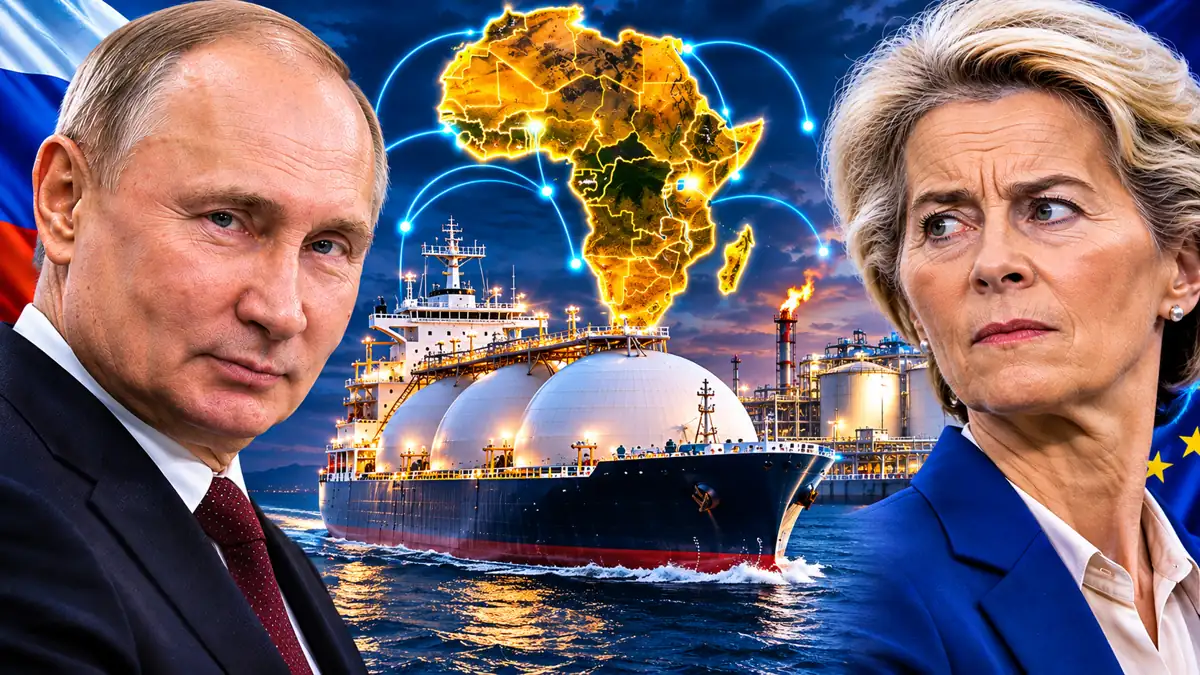 Russia is exploring a new direction for its liquefied natural gas industry. As the European Union moves toward a complete ban on Russian LNG imports, NOVATEK has presented an ambitious concept for an integrated energy hub in Africa. The project could combine gas reception, storage, regasification and electricity generation on a single offshore platform.
A Changing Global Energy Market
The global natural gas market is undergoing a significant transformation.
For decades, Europe represented one of Russia's most important energy destinations. Russian pipeline gas supplied industries, power generators and households across several European countries.
That relationship has changed dramatically since 2022.
European governments have pursued policies intended to reduce dependence on Russian energy imports, citing security concerns and Russia's invasion of Ukraine.
Under the European Union's adopted regulations, Russian LNG imports under long-term contracts are scheduled to end on January 1, 2027. The transition period for pipeline gas extends further into 2027.
For Russian producers, this creates a strong incentive to diversify export markets.
Asian demand remains important, but geography, shipping costs and competition present commercial challenges.
Against this background, Africa is increasingly being discussed as a potential destination for Russian energy technology and LNG.
What NOVATEK Announced
On October 28, 2026, during Russia–Africa business discussions, NOVATEK presented a concept for a new industrial energy hub.
Sergey Solovyov, a deputy chairman of the company's management board, described a technology- based proposal combining LNG infrastructure with electricity production.
The concept involves a gravity-based offshore platform designed to operate near the African coastline.
Rather than requiring several separately constructed facilities, the proposed hub would integrate multiple functions into one industrial structure.
These include a berth for LNG carriers, gas storage, regasification equipment and a power generation facility.
This integrated approach is the central feature of NOVATEK's proposal.
The company argues that conventional LNG importing systems can require separate infrastructure projects, separate investors and extensive construction schedules.
A combined facility could potentially simplify development and accelerate the delivery of electricity. However, those advantages would need to be demonstrated through detailed engineering and commercial studies.
The Technical Specifications
According to descriptions of Solovyov's presentation, the proposed platform would measure approximately 290 metres by 70 metres.
It would be installed on the seabed at a water depth of up to 13 metres.
The facility is designed to receive as much as seven million tonnes of LNG annually, equivalent to approximately ten billion cubic metres of natural gas.
Its planned electricity generation capacity could reach one gigawatt.
That combination is significant because the facility would not simply import gas. It could also convert a portion of the imported fuel into electricity for industrial and residential consumers.
The platform would be manufactured at a specialised shipyard and subsequently transported to its selected coastal location.
In principle, preparation work at the destination could take place while the platform is being built. That might reduce the amount of construction required directly at the final site.
NOVATEK has indicated that final commissioning work could be relatively short after delivery, assuming the necessary connections and approvals are ready. The actual schedule would depend on local conditions, engineering assessments and investment decisions.
Why Africa Matters
Africa is not a single energy market. It comprises more than fifty countries with different income levels, natural resources, regulatory systems and energy priorities.
Some states already produce and export significant volumes of natural gas. Others face major difficulties in supplying reliable electricity to households and businesses.
The continent also contains numerous landlocked countries.
These nations often depend on infrastructure located beyond their own borders to import fuel, obtain electricity or transport industrial equipment.
A coastal LNG hub supplying neighbouring markets could therefore offer an alternative regional development model.
Gas could be delivered to local consumers through pipelines, while electricity could be transmitted through interconnected power networks.
Such an arrangement might help support manufacturing, logistics, public services and other economic activities.
But it would also require cooperation between governments and infrastructure operators. Cross- border tariffs, transmission capacity, legal agreements and long-term commercial commitments would all be essential.
A Potential Market of 20–30 Million Tonnes
NOVATEK's representative estimated that Africa's prospective LNG demand could reach approximately 20–30 million tonnes per year in the near term.
This figure reflects potential or unmet demand rather than existing contracted purchases. The distinction is important.
A population in need of energy does not automatically translate into an economically viable LNG market.
Successful projects depend on the ability of customers to pay, appropriate fuel prices, reliable distribution networks and stable regulatory conditions.
LNG also competes with other energy sources, including domestic natural gas, hydropower, solar energy and other forms of generation.
For some countries, imported LNG may provide valuable flexibility. For others, alternative energy investments may prove more affordable.
The commercial opportunity therefore needs to be evaluated country by country.
Russia's Engineering Experience
NOVATEK has experience using gravity-based structures in its Arctic LNG developments.
These large platforms can be constructed at dedicated industrial facilities before being transported to their operational locations.
The company now wants to explore whether similar engineering methods could serve African energy markets. There are potential advantages. An integrated platform could avoid the need for several separate onshore and offshore industrial sites. It could also reduce certain construction interfaces and coordination challenges.
However, moving from an Arctic industrial project to a coastal African energy installation is not a simple copy-and-paste exercise.
Local marine conditions, weather patterns, seabed characteristics, environmental standards and grid requirements would all need to be considered.
Every proposed location would require its own technical assessment.
The Financial Challenge
The biggest obstacle may not be technology. It may be financing.
A large LNG energy hub would require substantial capital investment, together with money for pipelines, electricity connections and supporting infrastructure.
Long-term contracts would be essential to establish predictable revenues.
Unlike a floating LNG terminal that can potentially be relocated, a gravity-based platform is intended to remain at its installation site.
This makes the quality of future demand forecasts especially important.
NOVATEK has mentioned international development institutions, including the World Bank and the African Development Bank, as possible financing partners.
No confirmed funding arrangement was announced as part of the proposal.
Any future investment would also need to comply with applicable legal, banking and sanctions requirements. Financing conditions could therefore have a decisive influence on whether the idea progresses.
Can Africa Replace Europe?
The African opportunity should not be treated as an immediate replacement for the European gas market.
Europe developed its import infrastructure and gas consumption patterns over many decades.
Large sections of Africa would first need expanded energy networks, industrial investment and stable purchasing arrangements.
Nevertheless, new regional LNG hubs might become part of a broader diversification strategy for Russian exporters.
If successful, they could generate demand for gas supplies, engineering services, equipment and technical expertise.
African participants, meanwhile, could benefit from additional energy infrastructure and greater supply options.
The outcome would depend on whether projects deliver competitively priced electricity and commercially sustainable contracts.
A Proposal With Strategic Implications
For now, NOVATEK's African energy hub remains a proposal.
Specific locations, final investment decisions and full commercial agreements have not yet been announced. That limits what can reasonably be concluded about construction timelines or future export volumes.
Nevertheless, the announcement reflects a broader shift in international energy relationships.
Russia is seeking new markets, while African governments are considering multiple partners and technologies to meet growing electricity demand.
The eventual winners will not be determined by political announcements alone. They will be determined by finance, engineering, dependable supply and the cost of energy delivered to customers.
Europe is changing its energy relationships. Russia is exploring alternatives. And Africa is becoming an increasingly important arena for future energy investment.
Sources: Interfax — https://interfax.com/newsroom/top-stories/119718/; PortNews — https://portnews.ru/news/398925/; Council of the EU — https://www.consilium.europa.eu/en/press/press-releases/2026/01/26/russian-gas-imports-council-gives-final-greenlight-to-a-stepwise-ban/.
Illustration: editorial composite, not a documentary photograph of an event.