AN INDEPENDENT VIEW OF WORLD EVENTS EDITORIAL DESK | ENRU 
GEOPOLITICS · 20/11/2026
Putin, Trump and Xi in Shenzhen: A New Yalta or High-Stakes Diplomacy for Three?
Putin, Trump and Xi are due to meet in Shenzhen on November 19. Nuclear arms, Iran, Europe and the “Yalta 2.0” analogy: facts and analysis.
 Prepared on November 17, 2026, before the meeting scheduled for November 19. This article reflects pre-meeting expectations and does not report its outcome.
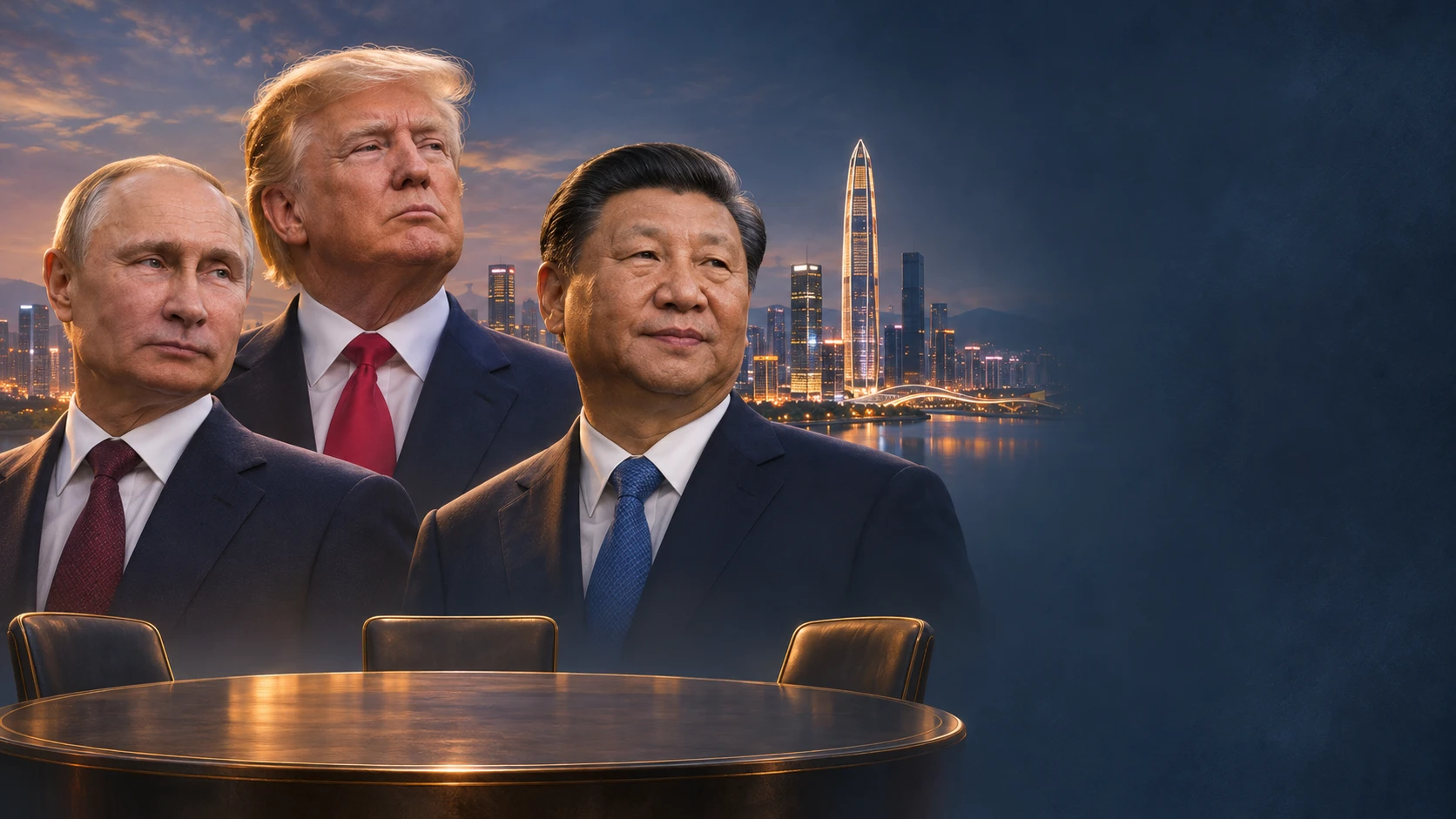
A first-ever three-way meeting between Vladimir Putin, Donald Trump and Xi Jinping is scheduled for November 19, 2026, on the sidelines of the APEC leaders’ summit in Shenzhen, China. The symbolism is unmistakable. Commentators have already reached for the phrase “Yalta 2.0,” suggesting that the major powers may be preparing to rewrite the rules of world politics. The evidence, however, points to something more complicated than a single grand bargain.
The meeting is confirmed. Its outcome is not.
As of November 17, officials from the United States, Russia and China have confirmed plans for the trilateral meeting. The APEC Economic Leaders’ Meeting takes place on November 18–19, while the Putin–Trump–Xi talks are expected on Thursday, November 19. No final agreement or joint statement has been announced in advance.
The format itself is unprecedented: although the three leaders have held bilateral talks, they have not met together in this configuration. That alone makes the event diplomatically significant. Direct contact matters most when rival capitals cannot agree on the terms of the conversation, let alone its conclusions.
Why the “Yalta 2.0” comparison is tempting — and misleading
The 1945 Yalta Conference evokes the image of major powers negotiating the postwar order. Calling Shenzhen a second Yalta turns a complicated agenda into an irresistible picture: three leaders, one table and an entire world outside the room. Yet the analogy is an interpretation, not an agreed blueprint for dividing spheres of influence.
The experts cited in the editorial source material do not speak with one voice. Some see the meeting as a marker of a more multipolar system. Others expect a modest opening conversation, perhaps a photo opportunity and a commitment to keep talking. Both interpretations should be presented as analysis rather than settled fact.
Nuclear weapons: one issue, sharply different interests
Washington has highlighted nuclear arms reductions as a priority and wants China involved in future discussions. Beijing has resisted the idea of joining a three-way disarmament framework on the same terms as the United States and Russia, arguing that their stockpiles are considerably larger. What sounds like a straightforward appeal for stability therefore runs into a difficult question of starting positions.
The challenge is not simply whether three leaders can endorse a reassuring sentence. Credible arms control requires definitions, verification, reciprocal concessions and sustained negotiations. A brief summit can launch such a process, but it cannot substitute for the years of technical and political work that may follow.
Iran, Ukraine and an agenda that does not line up
US officials have indicated that Trump wants to discuss the war in Iran. Russia and China have different interests and relationships in the region, making an easy consensus unlikely. There is also disagreement over Ukraine. Reporting ahead of the summit suggests that Washington does not intend to raise the Russia–Ukraine war in the three-way format, while Moscow regards the subject as important in its broader contacts with the United States.
China has signalled reluctance to treat the Ukraine war as a subject for decisions by three external powers alone. That position also exposes a limitation in the “new Yalta” metaphor: international disputes involve actors and institutions far beyond the three governments in the room.
Does Europe have a seat at the table?
The absence of an EU representative from the trilateral meeting is politically revealing, but it should not be confused with a formal decision to exclude Europe from world affairs. APEC is an Asia-Pacific economic forum, and the side meeting is not a legal assembly assigning global ranks to countries or regions.
Still, the optics matter. European capitals face an uncomfortable question: how can they shape strategic decisions when other powers hold direct talks? Influence cannot be measured solely by invitations. It also depends on economic strength, security capabilities and the ability to formulate policies that others must take seriously.
What would count as a meaningful result?
A substantive outcome could include an agreed process for strategic-stability talks, practical measures to lower nuclear risks or a commitment to sustained diplomatic channels. A group photograph and a carefully worded press statement would be more modest. They would not necessarily be worthless, but they would hardly amount to the establishment of a new world order.
Shenzhen is not Yalta — at least not on the evidence available before the meeting. It may nevertheless be an important opening chapter in a longer negotiation. The most consequential question is not who looks strongest in the photograph. It is whether any of the leaders can turn a symbolic encounter into decisions that survive the cameras.
Sources listed in the editorial document
МИД Китая — программа саммита АТЭС, 13.11.2026
https://www.fmprc.gov.cn/mfa_eng./xw/zyxw/202611/t20261113_12058556.html
Anadolu Agency — подтверждение встречи, 16.11.2026
https://www.aa.com.tr/en/asia-pacific/china-confirms-xi-to-meet-with-us-and-russian-presidents-at-summit-on-sidelines-of-apec/4126087
Channel News Asia — повестка и позиции сторон, 17.11.2026
https://www.channelnewsasia.com/east-asia/apec-summit-2026-china-shenzhen-trump-xi-putin-6545366
Associated Press — ожидания и пределы переговоров, 14.11.2026
https://apnews.com/article/5fe92253ef38100bae913834a9b74d72